
Sitemap
A list of all the posts and pages found on the site. For you robots out there, there is an XML version available for digesting as well.
Pages
Posts
Future Blog Post
Published:
This post will show up by default. To disable scheduling of future posts, edit config.yml and set future: false.
Blog Post number 4
Published:
This is a sample blog post. Lorem ipsum I can’t remember the rest of lorem ipsum and don’t have an internet connection right now. Testing testing testing this blog post. Blog posts are cool.
Blog Post number 3
Published:
This is a sample blog post. Lorem ipsum I can’t remember the rest of lorem ipsum and don’t have an internet connection right now. Testing testing testing this blog post. Blog posts are cool.
Blog Post number 2
Published:
This is a sample blog post. Lorem ipsum I can’t remember the rest of lorem ipsum and don’t have an internet connection right now. Testing testing testing this blog post. Blog posts are cool.
Blog Post number 1
Published:
This is a sample blog post. Lorem ipsum I can’t remember the rest of lorem ipsum and don’t have an internet connection right now. Testing testing testing this blog post. Blog posts are cool.
portfolio
Portfolio item number 1
Short description of portfolio item number 1
Portfolio item number 2
Short description of portfolio item number 2
publications
Dental restoration using a multi-resolution deep learning approach
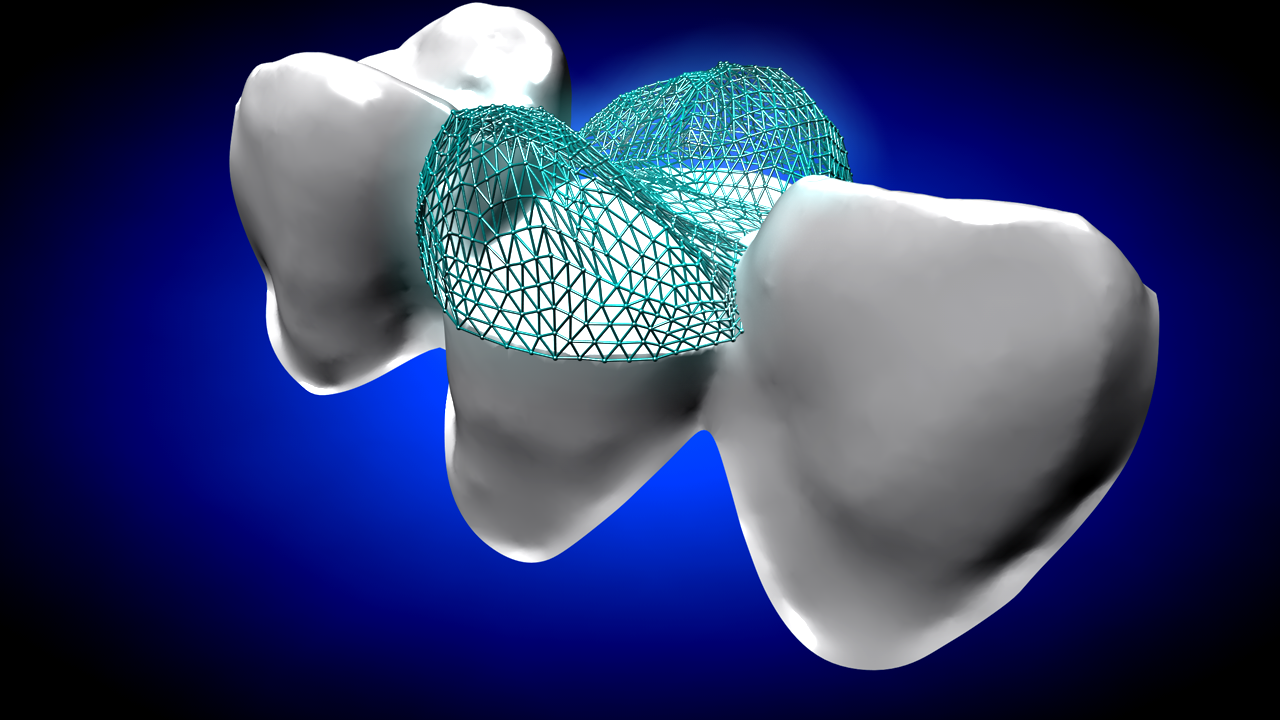
Published in ISBI, 2022
Computer assisted design software is currently used by technicians to design dental crowns. However, this process involves manual adjustments that are time consuming and lead to great variability in quality of the design since they depend on the technician’s experience. We developed a fully automatic approach that learns from natural teeth in dental scans using 3D conditional shape completion. Our work extends depth map-based approaches to generate crown shapes in 3D directly. Using a Generative Adversarial Network (GAN), our deep learning model is able to generate patient-specific point clouds of teeth starting from normalized incomplete point clouds. The model generates a crowns outer surface that looks realistic, with a mean Chamfer Distance (CD) of 0.55 millimiter when compared to real teeth.
Semi-supervised segmentation of tooth from 3D scanned dental arches
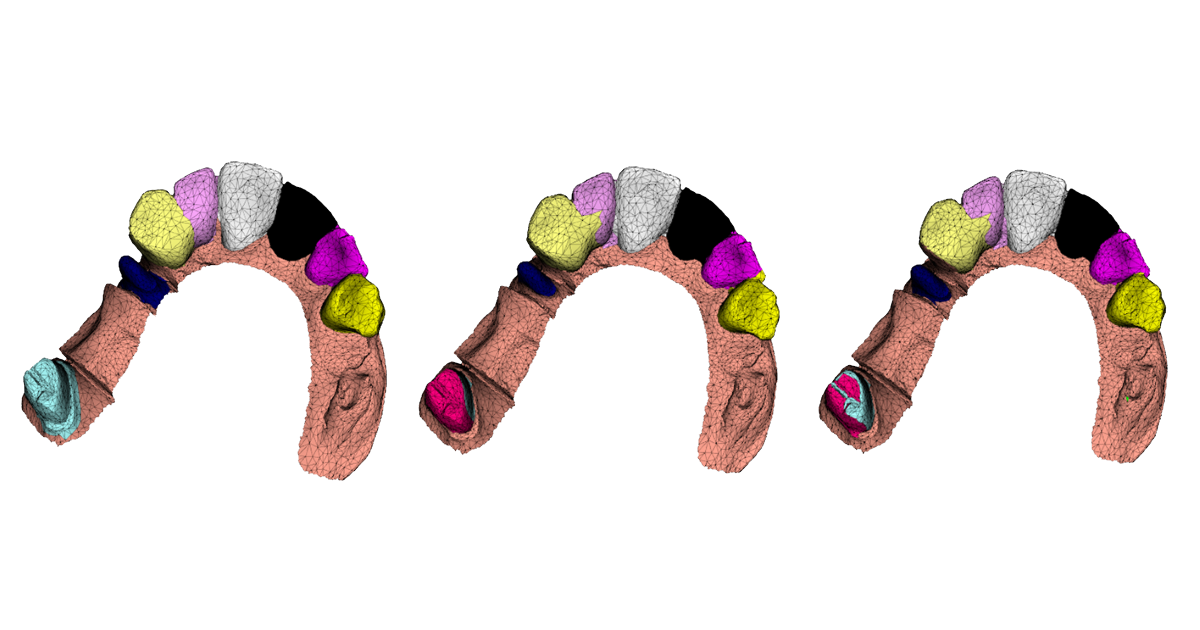
Published in SPIE, 2022
Dental offices tackle thousands of dental reconstructions every year. Complexity and abnormalities in dentition make segmentation of an optical scan a challenging manual task that takes 45 minutes on average. The present work improves the generalization of currently available deep learning segmentation model on 3D dental arches by introducing a new loss function to leverage unlabeled available data. The semi-supervised segmentation network is trained using a joint loss that combines a supervised loss of annotated input and a self-supervised loss of non-labeled input. Our results showed that combining self-supervised and supervised learning improved the segmentation score by 13 % compared with purely supervised learning for the same amount of labeled data. It is concluded that combining representations obtained from self-supervised learning with supervised learning improves the generalization of the 3D tooth segmentation model in the case of few available labeled data.
IDTrust: Deep Identity Document Quality Detection with Bandpass Filtering
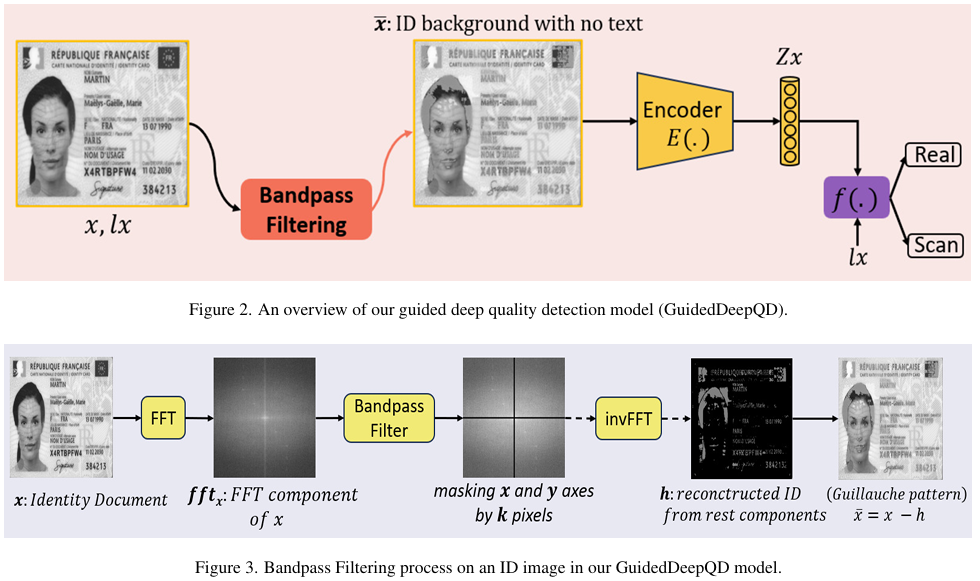
Published in WACV, 2025
The increasing use of digital technologies and mobile-based registration procedures highlights the vital role of personal identity documents (IDs) in verifying users and safeguarding sensitive information. However the rise in counterfeit ID production poses a significant challenge necessitating the development of reliable and efficient automated verification methods. This paper introduces IDTrust a deep-learning framework for assessing the quality of IDs. IDTrust is a system that detects the quality of identity documents using a deep learning-based approach. This method eliminates relying on original document patterns for quality checks and pre-processing steps for alignment. As a result it offers significant improvements in terms of dataset applicability. Using a bandpass filtering-based method the system aims to detect and differentiate ID quality effectively. Comprehensive experiments on the MIDV-2020 and L3i-ID datasets identify optimal parameters significantly improving discrimination performance and effectively distinguishing between original and scanned ID documents.
Optimizing identity documents classification in online systems: A comparative analysis
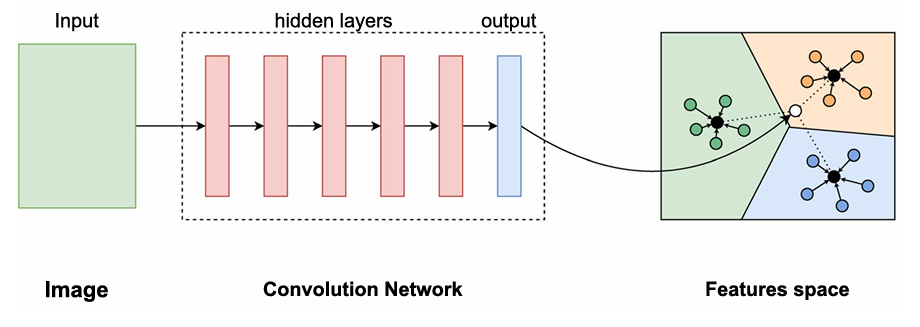
Published in IJDAR, 2025
Nowadays, administration and other bank business interactions are increasingly carried out with online systems. One main problem with this type of interaction is verifying the user’s identity to prevent usurpation. This article focuses on the initial classification process of these systems, mainly smartphone applications for identity document (ID) check. Indeed, these systems need a classification as a pre-processing to identify the type of document and adapt the security element verification accordingly. The context includes some constraints such as limited computing resources and processing speed requirements. There are also some advantages: The documents supposed to be found are known a priori and ID is a highly standardized type of document. To perform this document image classification, this article compares multiple solutions and proposes our improvement to match these challenges and then discusses which could be the best solution in which situation. These solutions include convolutional deep neural networks (CNN), prototypical networks (ProtoNet), and reduced descriptor matchers (RDM). The evaluation shows that the prototypical network and the best-reduced descriptor matcher method have close results, but different weaknesses. CNN clearly outperforms ProtoNet and RDM in terms of accuracy, but ProtoNet is on par in terms of computing speed. RDM’s weaknesses make it unsuitable for our context and CNN need too many training samples to be used efficiently. As a result, improving ProtoNet seems to be the best option.
talks
Revolutionizing Identity Verification: Deep Learning-based Facial Recognition for Identity Documents

Published: